Introduction:
First, we must establish what the Filioque means before we argue for the acceptance of the phrase. The doctrine comes from the Latin version of the Nicene creed, where the term “Filioque” (and the Son) appears after “Proceeds from the Father” in the original version. There are multiple ways in which this phrase can be interpreted. In its most extreme form, it is interpreted to mean that there are two separate principles of the Holy Spirit, the Father, a single principle of spiration, and the Son, another principle of spiration.
Latin theology (mostly) has rejected this interpretation in favor of a more “moderate” reading of the phrase. That is, the Father and the Son form, together, one principle of the Holy Spirit. The Father is the “immediate cause” and the Son the “mediate cause” of the Holy Spirit. This is helpfully described as “from the Father through the Son,” glossing “que” (and) to mean “per” (through). It is this interpretation of the Filioque that will be defended in this article. It is important to note that great strides have been made been the Latins and Greeks on this issue of the Filioque. This language of “one shared principle” and “through the Son” has been received by many in the east.
The Argument:
The central reason why the theology of the Filioque must be retained is that otherwise, we would not be able to distinguish the hypostasis (person) of the Son and the hypostasis of the Spirit. In brief, the persons of the Trinity are only distinguished from their processions; the Son proceeds from the Father alone (as all admit); therefore, the Spirit could not proceed from the Father alone, or else, there would be no way of distinguishing them. The first premise in this argument is that the persons of the Trinity can only be distinguished by their subsisting relations of origin and procession. It is admitted by all that they must be able to be distinguished. This distinction cannot be of substance, or else, the Trinity is split into three substances, and we would have three gods. There would be no “consubstantial.” Therefore, as Boethius says, “quod sola relatio multiplicat Trinitatem divinarum personarum” (Relation alone multiplies the Trinity of the divine persons).
Further, these relations must also be opposite relations (i.e., from x to y) in order to truly distinguish. This is vital to the thesis given above. For one may argue, “the Son and Spirit may be distinguished from the fact that they are different processions from the Father.” This does not suffice because they must be opposite relations. For, in this scheme, they both have opposite relations to the Father (and thus can be distinguished from Him). However, they do not have opposite relations to each other. This appears from the case of the Father. For, He has two relations, first, from the fact that He generates the Son, and second, from the fact that He spirates the Spirit. Why, then, do we not distinguish these into two Fathers? We do not distinguish because these relations are not opposite relations. Therefore, if we are to only distinguish the Son and Spirit from the fact that they both proceed from the Father, we would have no principle of distinction because these are not opposite relations. We would have as much basis of distinguishing the Son and Spirit as we would Father 1 and Father 2. Therefore, we must not only posit an opposite relation of the Son to the Father and the Spirit to the Father but also of the Son to the Spirit.
Lastly, the only opposite relations that can distinguish are relations of origin. For, a relation can either be of quantity (half/double) or of act (doer/done to). We know it cannot be the former, for there is no quantity in God that can be split up (and this would lead to Tritheism). Therefore, it must be of act. With act, it can either be external or internal. It cannot be external, for that would break the unity of God; therefore, it must be internal actions, i.e., procession and origin. Therefore, it must be an internal act (procession and origin) wherein the two persons stand in opposition to one another. This can either be achieved, a., the Son from the Father and the Spirit (which is discounted easily), or b. the Spirit from the Father and the Son, which is established by elimination and necessary consequence.
Conclusion:
Scriptural witness:
Titus 3:5-6: “[H]e saved us, not because of deeds done by us in righteousness, but in virtue of his own mercy, by the washing of regeneration and renewal in the Holy Spirit, which he poured out upon us richly through Jesus Christ our Savior.”
Acts 2:33: “Being therefore exalted at the right hand of God, and having received from the Father the promise of the Holy Spirit, he has poured out this which you see and hear. More InfoNotice that the Spirit is said to be breathed forth by the Son in the economy, showing that the Son spirates the Spirit. The Spirit is said to be poured forth from the Father through the Son in the economy, showing that the Spirit hypostatically proceeds from the Father through the Son. Finally, the Son is said to receive the Holy Spirit and pour Him forth in the economy, showing that the Son receives the spirative power from the Father and thus spirates the Spirit. The Church fathers used this same argument for the Filioque demonstrating that this is not merely a novel attempt to prove the doctrine.
Ex., St. Augustine - On the Trinity, Book IV, Ch. 20, Para. 29
“Nor do I see what else He intended to signify, when He breathed on the face of the disciples, and said, ‘Receive the Holy Ghost.’ For that bodily breathing, proceeding from the body with the feeling of bodily touching, was not the substance of the Holy Spirit, but a declaration by a fitting sign, that the Holy Spirit proceeds not only from the Father, but also from the Son.”
More Info
The Spirit being breathed by the Son in the economy is a fitting sign that He proceeds from the Son. Now, a sign points toward a distinct reality; therefore, the economic breathing of the Spirit does not serve as a sign of the economic procession of the Spirit; rather, it serves as a sign for the eternal spiration of the Spirit. Here, we have St. Augustine using the Son breathing forth of the Spirit as proof for the Spirit’s hypostatic procession from the Son.
Ex., St. Caesarius - Sermon 213 - On the Divine Nature of the Holy Spirit (II)
“But someone of you asks me whether the Holy Spirit should be confessed as unbegotten, begotten, or something else. Sacred Scripture speaks about the godhead and divinity of the Holy Spirit, but does not say whether He should be called begotten or unbegotten. [...] He did not say ‘begotten,’ lest you believe Him the Son; He did not say ‘unbegotten,’ so you would not think Him the Father. [...] Because the Holy Spirit proceeds from Both Persons, it is said: ‘If anyone does not have the Spirit of Christ, he does not belong to Christ’; and in another place: ‘He breathed on them and said: ‘Receive the Holy Spirit.’”
Caesarius of Arles, Sermon 213, trans. Mueller, 106-7.
More Info
St. Caesarius claims that the Spirit hypostatically proceeding from both the Father and the Son is the reason why the Spirit is breathed forth by the Son in the economy.
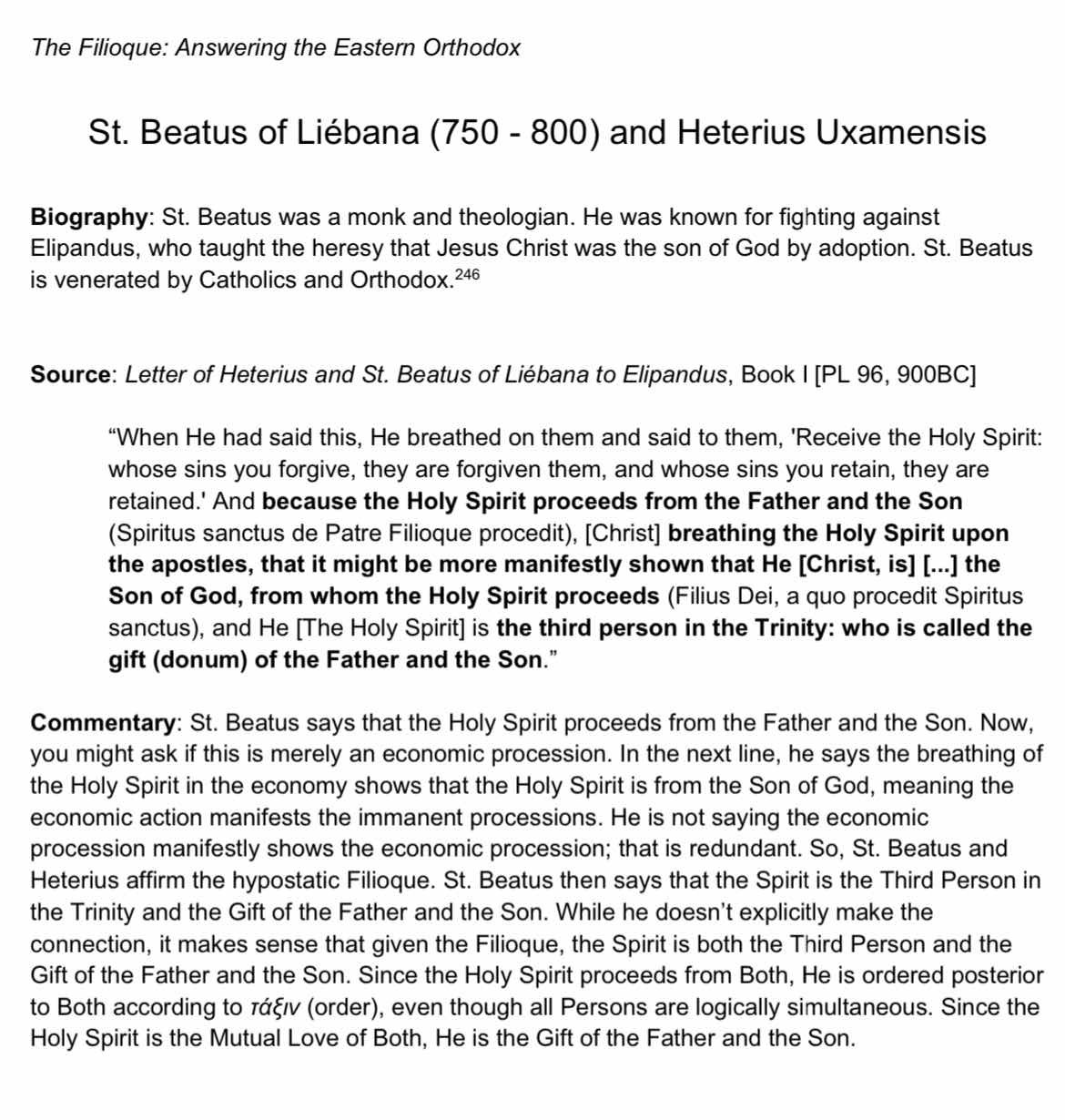
Ex., Letter of Heterius and St. Beatus of Liébana to Elipandus, Book I [PL 96, 900BC] “When He had said this, He breathed on them and said to them, 'Receive the Holy Spirit: whose sins you forgive, they are forgiven them, and whose sins you retain, they are retained.' And because the Holy Spirit proceeds from the Father and the Son (Spiritus sanctus de Patre Filioque procedit), [Christ] breathing the Holy Spirit upon the apostles, that it might be more manifestly shown that He [Christ, is] [...] the Son of God, from whom the Holy Spirit proceeds (Filius Dei, a quo procedit Spiritus sanctus).”
More InfoThe Son breathing the Holy Spirit shows that the Spirit hypostatically proceeds from the Son.
Ex., Oratio I - De SS Trinitate, 27 [PG 89, 1328A] “[A]nd again, the Holy Spirit, who appears together with the Father and the Son, as with Mind and Word. And in fact the Lord, showing that he exists out of himself (ex se ipso ipsum exsistere), said, when breathing upon the disciples, ‘Receive ye the Holy Ghost’ (John 20:22); and when these latter prayed with the imposition of their own hands, they supplied him to those who believe.”
The Spirit being breathed forth by the Son shows that the Spirit exists out of the Son.
1. The hypostatic property (ίδιος) of the Spirit is His dependence on the Son
2. Demonstrated by Saint Athanasius
2. The distinction between the properties of the Spirit and Son is found in the mediation of the Son in the spiration of the Spirit
3. Demonstrated by Saint Gregory of Nyssa and Saint Gregory the theologian
3. The Son is an αιτία of the Spirit
4. Demonstrated by Saint Basil
First, the ίδιος of the Spirit
ίδιος - A proper characteristic that is not shared between the three persons of the Trinity (can either be unique or shared by two)
This is something hypostatic
In order to demonstrate the Filioque, one would need to show an "idiomatic" (proper) relationship between the Spirit and Son
Saint Athanasius
First, "We shall find that the Spirit has to the Son the same proper relation as we have known the Son to have to the Father." (Ad Serapion, PG, 26:625A-B) What is the "proper relation" that the Son has to the Father? It’s begetting.
Second, "in regard to order and nature the Spirit bears the same relation to the Son as the Son to the Father." (Ad Serapion, PG, 26:576D-80B.) Explains by order and nature, thus, cannot be "energetic" or "temporal" The Son has a hypostatic relationship with the Spirit (i.e. procession)
Third, "because he [the Spirit] is proper to the Word who is one, he is proper to God [the Father] who is one, and one in essence with him." (PG, 26:589) Grounds the relationship between the Spirit and Father, thus cannot be "energetic" or "temporal"
St. Basil explains the teaching well in De Spiritu Sancto: "[The Spirit is] conjoined as He is to the one Father through the one Son, and through Himself completing the adorable and blessed Trinity" Second, distinction between the ιδιοματα of the Spirit and Son Fathers say that being "from another" is the property BOTH of the Son and Spirit This leads them to ask "how are the Son and Spirit distinct?"
They answer that the distinct property of the Spirit is to receive his existence through the Son or with the mediation of the Son In order to prove the Filioque, one would merely need to show that the distinction of ιδιοματα is a relationship between the two While we confess the invariable character of the nature, we do not deny the difference in respect of cause, and that which is caused, by which alone we apprehend that one Person is distinguished from another; — by our belief, that is, that one is the Cause [Father] and another is of the Cause [Son/Spirit]; and again in that which is of the cause [Son/Spirit] we recognize another distinction. For one is directly from the first Cause [Son], and another [i.e., the Spirit] by that which is directly from the first Cause [i.e., the Son]; so that the attribute of being Only-begotten abides without doubt in the Son, and the interposition of the Son, while it guards His attribute of being Only-begotten, does not shut out the Spirit from His relation by way of nature to the Father. (“St. Gregory of Nyssa, On “Not Three Gods” - PG, 45:133B-C) “It is common to the Son and the Holy Spirit that they do not exist as unbegotten, lest any confusion arise on this matter, again we can find an incommunicable difference in their properties, so that what is common may be preserved and what is proper may not be confused. For the only-begotten Son is said by Scripture [to be] from the Father, and in this way the word defines what is proper to him. But the Holy Spirit is said (to be) from [έκ] the Father and is also testified to be from [έκ] the Son. . .the Son, who is of God is not and is not said to be the Son of the Spirit; the terms of the relationship cannot be reversed."
Third, the Son as αιτία of the Spirit The Son is said (by some) Greek fathers to be the "αιτία" (cause) of the Holy Spirit's existence, which clearly refers to hypostatic existence In order to prove the Filioque, one simply needs to demonstrate that the Son is αιτία
St. Basil clearly teaches this: " For as the Son is bound to the Father, and, while deriving existence from Him, is not substantially after Him, so again the Holy Spirit is in touch with the Only-begotten, Who is conceived of as before the Spirit's subsistence according to the idea of cause [κατά τόν τής αίτίας λόγον]." (Contra Eunomium 1 - PG, 45:464B-C)
First, the parallel at the beginning of the passage that as the Son is bound to the Father, and, while deriving existence from Him, is not substantially after Him..." would not make sense.
Second, the explanation that he gives in the sentence after would not make sense, "Extensions in time find no admittance in the Eternal Life." Thus, clearly, internally we see that he means to say κατά τόν τής αίτίας λόγον in order to exclude difference of time
Third, in the previous paragraph, he says the same about the Father and gives the same explanation, "if, in conceiving of the Father before the Son according to the account of cause alone [τής αίτίας λόγωι], we inserted any mark of time before the subsistence of the Only-begotten, the belief which we have in the Son's eternity might with reason be said to be endangered."
Fourth, St. Basil supports this by using this exact phrase and explaining it in line to what we say (longer discussion in 1.20), "All that remains, then, is that greater than is said here according to the account of cause [κατά τόν τής αίτίας λόγον]. Since the Son's principle comes from the Father, it is in this sense that the Father is greater, as cause and principle." (CE 1.24) Thus, extrinsically, it is also clear that κατά τόν τής αίτίας λόγον means to merely exclude priority/posteriority of TIME, not one of hypostatic existence
What we know. The attributing of anything to another involves the attribution likewise of whatever is contained in it. So when man is attributed to anyone, a rational nature is likewise attributed to him. The idea of relation, however, necessarily means regard of one to another, according as one is relatively opposed to another. So as in God there is a real relation (A. 1), there must also be a real opposition. The very nature of relative opposition includes distinction. Hence, there must be real distinction in God, not, indeed, according to that which is absolute—namely, essence, wherein there is supreme unity and simplicity—but according to that which is relative. Although relations, properly speaking, do not arise or proceed from each other, nevertheless they are considered as opposed according to the procession of one from another.
From this we see that for two properties to be distinguished, they must oppose one another. But filiation and passive spiration are not opposed.
The Holy Spirit is substantially distinguished from the Son in that the origin of the one differs from the origin of the other; but this very difference of origin is due to the Son’s being from the Father alone, whereas the Holy Spirit is from both the Father and the Son. Richard of Saint Victor makes this plain in On the Trinity 2, when he says: observe that this difference of properties consists merely in the number of persons producing, for the first has being from no other, the second from one only, the third from two.
Main Argument.
First, because things cannot be properly distinct from one another otherwise than either on account of a material or quantitative division or on account of a formal division.Now, distinction according to material and quantitative division is found in corporeal realities, wherein there are several individuals of the same species by reason of the specific form being found in diverse parts of matter according as it is quantity of the division. Wherefore, if there is an individual consisting of all the matter in which the form of the species is capable of existing, it is impossible that there be more than one individual of that species, as Aristotle proves about the world in On the Heavens 1 (Aristotle, On the Heavens 1.18–20, 277b9–279a10; cf. On the Heavens 1.17, 276b26–277a12). Now, this mode of distinction is utterly foreign to God, seeing that in him there is neither matter nor corporeal quantity. But a distinction of things that possess one nature, at least in their genus, cannot exist through a formal division except by reason of some opposition. Whence, we find that the differences of any genus are in opposition to one another.
And consequently, it is impossible and even inconceivable that there be any distinction save one of opposition in the divine nature, because it is one not only in genus but also in number. Wherefore, since the divine persons are distinguished from one another, this must be on account of a relative opposition, in that no other opposition is possible in God. This is sufficiently evident, since no matter how much certain things may differ according to a diverse account, for instance, the essential attributes, they do not distinguish the persons, since they are not mutually opposed to one another. Thus again, several notions are found in one divine person for the reason that they are not opposed to one another; for instance, in the Father there are innascibility, paternity, and active spiration. For we first find distinction where first there is relative opposition, for instance, in what it is to be Father and Son. Accordingly, in God, wherever there is no relative opposition, there can be no real distinction, which is a distinction of persons.
Now, if the Holy Spirit does not proceed from the Son, there will be no opposition between them, and so the Holy Spirit will not be a distinct person from the Son. Nor can it be said that, for this distinction, opposition of affirmation and negation is enough; for this sort of opposition follows distinction and does not cause distinction, since that which already exists is distinguished from another by something inhering in it either substantially or accidentally, whereas that this is not that is a result of their being distinct. Likewise, it is evident that the truth of a negative statement about things in existence is based on the truth of a positive statement; for example, the truth of this negation, “an Ethiopian is not white” is based on the truth of this affirmation, “an Ethiopian is black.” Wherefore, all differences in respect of affirmation and negation must be reducible to a difference of positive opposition. Consequently, the primary reason for the distinction between the Son and Holy Spirit cannot be that the Son is begotten and not spirated, the other spirated and not begotten, unless we presuppose a distinction between begetting and spirating, and between Son and Holy Spirit, by reason of an opposition between two affirmations.
Second, because according to Augustine, whatever is said of God absolutely is common to the three persons(Augustine, On the Trinity 6.2 — PL 42:925–26). Whence it follows that distinction between the divine persons can only be in respect of what is said to be toward-something; for these two categories are in the divine. Now, the primary distinction that is found according to relation in God is through these two things: that from which another one is and that which is from no one. But if one of these should be subdivided, namely, that which is from another, it must be subdivided through things that are of the same account. For as the Philosopher teaches, it does not follow the correct order of subdivision to subdivide a thing in reference to that which is accidental to it and does not belong to it through itself (Aristotle, Metaphysics 8.3, 1043b4–1044a14; 8.6, 1045a20–b23.); thus, if one were to say that animals are divided into rational and irrational, and irrational animals are divided into white and black, the division would not be correct, because, since things that are accidental do not combine to make that which is simply one, the ultimate species resulting from many differences would not be one thing, simply speaking.
Accordingly, if in God, he who is from another were to be distinguished or subdivided, this must be in reference to differences of the same account, namely, that one of those who is from another is from the other; and this involves a difference of processions, which is indicated when we say that one proceeds by generation, the other by spiration. Hence, Richard of Saint Victor distinguishes one proceeding from another thus: one has another proceeding from him and one does not
It follows, then, that either the Son and the Holy Spirit are one person or the Holy Spirit is from the Son.
Moreover, we shall come to the same conclusion if we consider the distinction of the divine persons in reference to their very origin but not to their relations of origin. This will be evident for the following reasons.
Argument Continued
First, if we consider what is proper to the divine nature, we shall see it is impossible that there be a plurality of divine persons unless through one originating from another, but in no way through two originating from one. This is made plain if we observe how distinction is found in diverse realities. For in the material realities, wherein, as stated above, it is possible for things to be multiplied by a division of matter and quantity, two individuals of the same species can be on an equal footing, just as two parts of a quantity may be equal. But where the primary difference is found to be according to form, it is impossible for two individuals to be on equal footing. For as the Philosopher says, the forms of things are like numbers, in which the species vary by the addition or subtraction of the unit, and the formal differences of things consist in a certain order of perfection
For the species of the plant differs from that of the stone in that it has life in addition, and the species of the brute animal from that of the plant in that it has sensation in addition, and man differs from the brute in that he adds reason. Wherefore, in immaterial realities, which cannot be multiplied by a division of matter, there cannot be plurality without some order. Indeed, in created immaterial substances, there is an order of perfection, insofar as one angel is of a more perfect nature than another. And because some philosophers thought that every imperfect nature is created by a more perfect one, they therefore contended that in separated substances there cannot be multiplication otherwise than by reason of cause and effect. The true faith, however, does not hold this, since we believe that the various orders of immaterial substances were brought into existence from the order of divine wisdom.
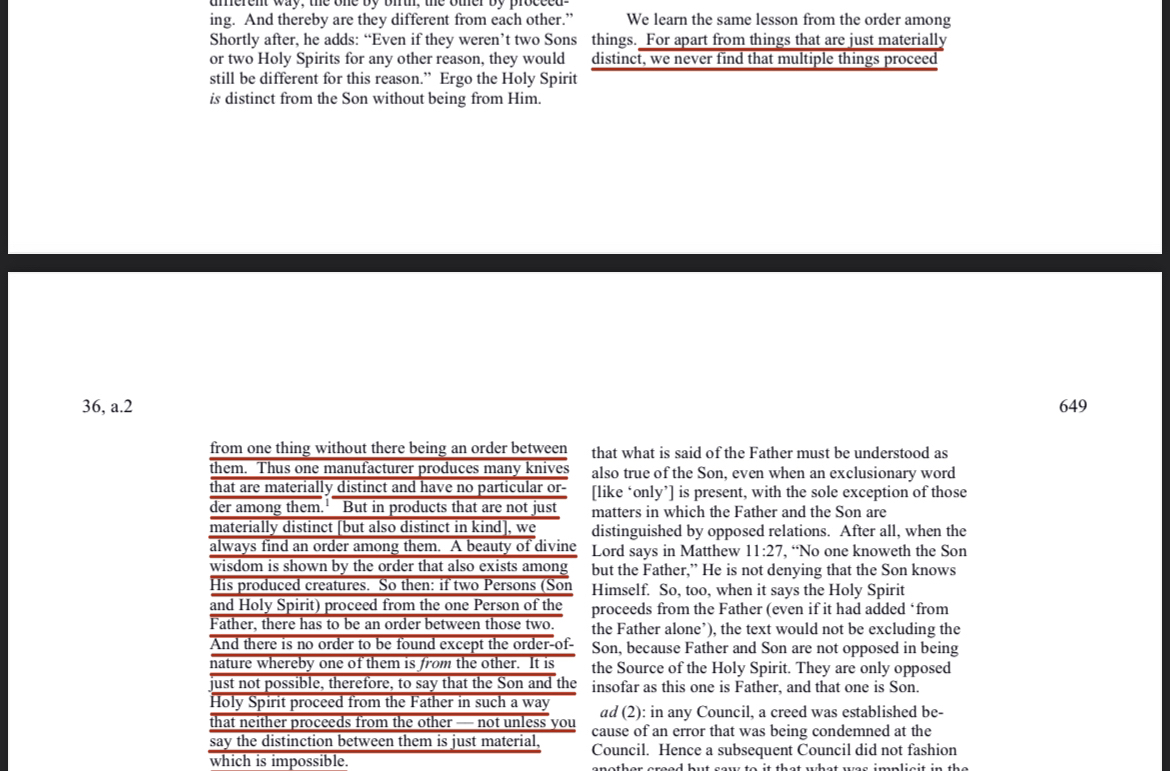
But since there cannot be order of perfection in God, as the Arians contended, saying that the Father is greater than the Son and each of them greater than the Holy Spirit, we must conclude that plurality in the divine persons cannot even be conceived otherwise than according to the sole order of origin, such that, namely, the Son is from the Father and the Holy Spirit from the Son. For if the Holy Spirit were not from the Son, then he would be related to the Father in an equal way in point of origin. Wherefore, either they would not be two persons, or there would be an order of perfection between them (as the Arians pretended), or there would be a material division between them (which is impossible). Hilary follows this line of argument when he says that to assert that in God there are two who are unbegotten, that is, who are not existing from another, is to posit two Gods
; for if multiplication is not by the order of origin, it must be by the order of nature. And the same argument avails if we do not acknowledge an order of origin between the Son and Holy Spirit.
Second, because that which proceeds naturally from one thing must itself be one; for nature is always oriented to one effect, whereas things that proceed from something through an acting will can be many even though they proceed from one; for example, from one God a diversity of creatures proceeded according to his will. Now, it is certain that the Son proceeds from the Father naturally and not through his will (as the Arians maintained); and this is because, as Hilary says, that which proceeds from its source naturally is of the same nature as its source, but that which proceeds according to an acting will is not of the same nature as he from whom it proceeds, but such as he wishes it to be
Now, the Son is such as the Father, while creatures are such as God wished them to be. Hence, the Son is from the Father naturally, and creatures are from him according to his will. In like manner, the Holy Spirit is such as the Father, for he is not a creature (as Arius and Macedonius asserted). Wherefore, he must proceed from the Father naturally, for which reason he is said, by Athanasius and other holy men, to be the natural Spirit of the Father and the Son. Consequently, it is impossible that the Son and Holy Spirit proceed from the Father except in such wise that from the Father alone proceeds one alone, namely, the Son, and from the Father and Son, inasmuch as they are one, proceeds one Holy Spirit.
Third, because as Richard proves, there cannot be a mediated procession in God
For because each divine person is within the other, each must be ordered immediately to the other. But if the Son and Holy Spirit were from the Father without the Holy Spirit being from the Son, there would not be an immediate order of the Holy Spirit to the Son, since they would not be ordered to each other except through the one from whom they exist, like two brothers begotten of one father. Hence, it is impossible that the Son and the Holy Spirit are from the Father in this way: as two distinct persons, such that one of them is not from the other.
Again, if we consider the distinction of the persons through an order to the essential attributes, we shall come to the same conclusion.
Argument Continued
First, because in this respect we say that the Son proceeds through the mode of nature and the Holy Spirit through the mode of will. For the procession of nature is always the principle and origin of every other procession; for all things that occur through art and the will or the intellect proceed from things that are according to nature. Hence, Richard says that it is certain that, of all modes of procession, the first and chief place belongs to the mode of proceeding that belongs to the Son from the Father. For unless the Father had preceded, neither of the other persons would have had any foundation for his existence
Second, this is evident if we realize that the Son proceeds by an intellectual procession as the Word, and the Holy Spirit by a procession of the will as Love. For it is both impossible and inconceivable that an object can be loved that has not first been understood by the intellect; wherefore, when speaking of love in an intellectual nature, all love proceeds from some word.
Third, it is evident, if we say with Athanasius that the Holy Spirit is the life-giving breath of divinity. For every vital movement and action is directed by understanding, unless the contrary occur on account of an imperfection of nature. Hence, from all that has been said we infer that the Holy Spirit would not be a person distinct from the Son if he did not proceed from him, nor would spiration be distinct from generation.
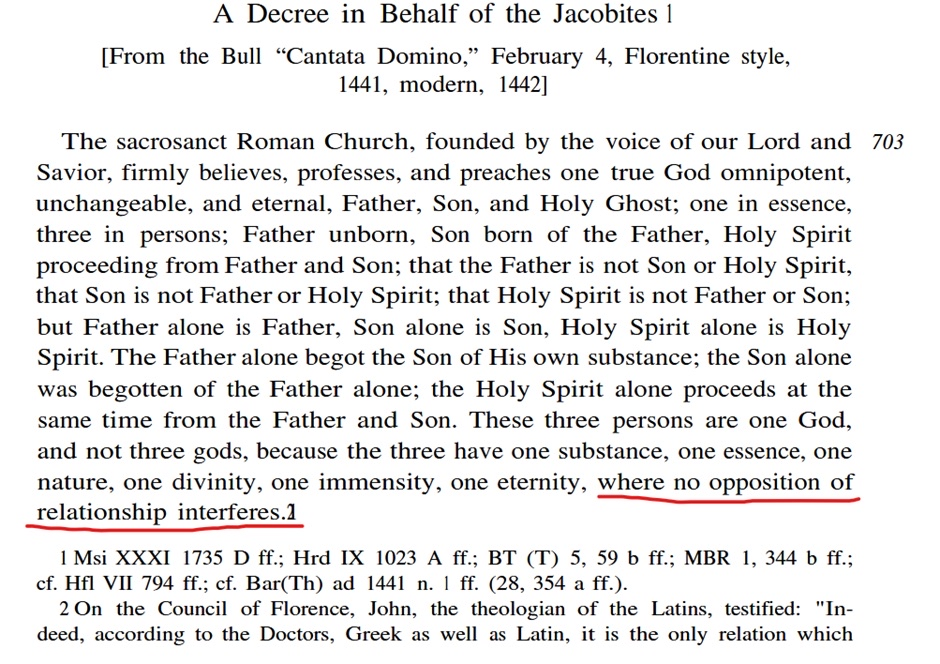
Whosoever will be saved, before all things it is necessary that he hold the Catholic faith. Which faith unless every one do keep whole and undefiled, without doubt he shall perish everlastingly. And the Catholic faith is this: that we worship one God in Trinity, and Trinity in Unity; neither confounding the Persons, nor dividing the Essence. For there is one Person of the Father; another of the Son; and another of the Holy Ghost. [...] For like as we are compelled by the Christian verity; to acknowledge every Person by himself to be God and Lord; So are we forbidden by the Catholic religion; to say, There are three Gods, or three Lords. The Father is made of none; neither created, nor begotten. The Son is of the Father alone; not made, nor created; but begotten. The Holy Ghost is of the Father and of the Son; neither made, nor created, nor begotten; but proceeding. So there is one Father, not three Fathers; one Son, not three Sons; one Holy Ghost, not three Holy Ghosts. And in this Trinity none is before, or after another; none is greater, or less than another. But the whole three Persons are coeternal, and coequal. So that in all things, as aforesaid; the Unity in Trinity, and the Trinity in Unity, is to be worshipped. He therefore that will be saved, let him thus think of the Trinity.
This subsection will show the widespread usage of the Athanasian Creed and will demonstrate that the Filioque doctrine was spread all throughout the Latin Church.
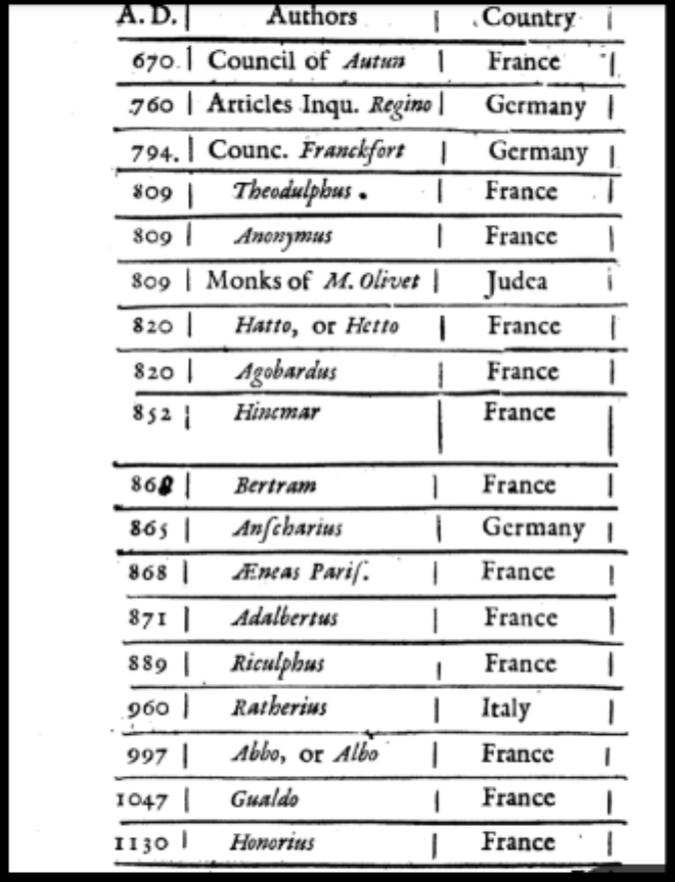
1. Usage: Here, we have a Church Father in France prior to 543 AD citing the Athanasian Creed as the standard of orthodoxy and agreeing that the Filioque doctrine is necessary for salvation. St. Caesarius, Sermon 3.
“Whosoever wants to be saved, brethren, above all must know and adhere to the Catholic faith. If anyone does not keep it whole and intact, doubtless he will perish forever. Moreover, this is the Catholic faith which we preach and believe. [...] Now, just as we are compelled by Christian truth to confess each Person singly God and Lord, so we are forbidden by the Catholic religion to say three gods or lords. The Father was made or created or begotten by no one. The Son was begotten by the Father alone, not made or created. The Holy Spirit was not made or created or begotten, but proceeds from the Father and the Son. Therefore, there is one Father, not three Fathers; there is one Son, not three Sons; there is one Holy Spirit, not three Holy Spirits. [...] Anyone, then, who wishes to be saved must feel thus about the Trinity.”
2. Usage: St. Venantius Fortunatus was one of the most prominent poets of his age. He is venerated by Catholics and Orthodox. St. Venantius wrote commentaries on the Lord’s Prayer, on the Apostles Creed, and on the Athanasian Creed, showing he viewed the Athanasian Creed with great authority, of high esteem like the Creed given to us by the Apostles themselves. In his commentary on the Athanasian Creed, he teaches the hypostatic Filioque, as the context is clearly about the hypostatic properties of the Persons. Here, we have another usage of the Filioque in the Athanasian Creed from France.
“Not therefore confounding the Persons, for there are three Persons altogether. For it is begetting, begotten and proceeding. The Father is begetting who begat the Son; The Son is begotten, whom the Father begat; The Holy Spirit is proceeding, because it proceeds from the Father and the Son (a Patre & Filio procedit).”
3. Usage: Here, we see a local council with over 60 bishops affirming the Filioque, using phrases from the Athanasian Creed, and we see that St. Isidore, a saint in both Churches, believes this is the Catholic faith. Furthermore, this shows that the Filioque was professed in what is now considered Spain in the early 7th century, showing the Creed spread to various countries.
“Since we are holding a general council, the first utterance of our voice ought to be about God, so that after our confession of faith the ensuing business may be established as it were on a most firm foundation [...] proclaiming the unity in the Godhead we neither confuse the persons nor divide the substance. We declare the Father to be made by none nor begotten; the Son we affirm to be not made by the Father but begotten; the Holy Spirit we profess to be neither created nor begotten, but proceeding from the Father and the Son. [...] This is the faith of the Catholic Church, this confession we preserve and hold fast: which whosoever shall most firmly keep shall have everlasting salvation.”
4. Usage: Here we have a saint venerated by both the East and West presiding over a local council in France, which forces clerics to learn the Athanasian Creed, showing the Filioque was a necessary belief and that the Creed was being held in high esteem next to the Apostles Creed. Second Synod of the Council of Autun 670, as described by John Kelly:
The Second Synod of the Council of Autun 670 A.D. was held under St. Leodegar who is venerated East and West. At the council, they refer to the Athanasian Creed as the “Faith of Saint Athanasius,” and they asserted, “If any priest or deacon or cleric cannot recite without mistake the creed which, inspired by the Holy Spirit, the apostles handed down, and the Faith of the holy primate Athanasius, he should be episcopally censured.”
5. Usage: St. Bruno, an early 11th century German bishop, quotes the Athanasian Creed, which is with regards to the hypostatic origin of the Persons, as previously demonstrated. Being not made, not created, nor begotten all refer to personal origin. So, the Spirit proceeding from both means St. Bruno affirms the Filioque. He then says that this is a hypostatic property that distinguishes the Persons. A bishop of Germany using the Athanasian Creed prior to the schism shows how far the Creed had spread throughout the West in his time.
"[Verse] 21. The Holy Spirit, from the Father and the Son, not made, nor created, nor begotten, but proceeding. [St. Bruno’s Commentary:] The Holy Spirit has His own property, because He is not the Father and the Son, but the Spirit proceeding from the Father and the Son (sed Spiritus procedens a Patre et Filio). You hear that He is from both, the Son from one, the Father from none (quia iste ab ambobus, Filius ab uno, Pater a nullo); and thereby their properties (proprietates) are clearly shown. Therefore, the Spirit of God is called, because the holiness of the Father and the Son is His; for since He is both the Spirit of the Father and the Spirit of the Son, and the Father is holy, and the Son is holy, yet He is properly called the Holy Spirit.
[Verse] 22. Therefore, one Father, not three Fathers; one Son, not three Sons; one Holy Spirit, not three Holy Spirits. [St. Bruno’s Commentary:] One Father, because He alone begot His only Son. And one Son, because He was singularly begotten by the one Father. One Holy Spirit, because He proceeds uniquely from the Father and the Son (a Patre et Filio unicus procedit)."
The Athanasian Creed was used for ordination, the education of clergy, and for catechesis of the laity. There was a Bishop-elect who used the Athanasian Creed to prove his loyalty to the Catholic faith prior to holy ordination, showing the Filioque is an orthodox teaching. In Kelly’s book, The Athanasian Creed, we hear, “A typical illustration is an ordinance attributed to Charlemagne which decreed, ‘These are the things all churchmen are ordered to learn: first, the Catholic faith of St. Athanasius . . .’ The other items include the Apostles’ Creed, the Lord’s Prayer, the order of mass, etc.” (Kelly, The Athanasian Creed, 42)
According to Siecienski in The Filioque (p. 56), the Creed of Damasus was a formula that was compiled either by Pope St. Damasus or by a council that presented the Creed to him. The context of the Creed is about the hypostatic properties of the Divine Persons, as begetting and being begotten are constitutive properties, not temporal or energetic processions. Therefore, the Holy Spirit proceeding from Both is His hypostatic property, clearly attesting to the hypostatic Filioque. The creed clearly speaks to the origin of the Spirit; thus it puts forth no other meaning than what the Council of Florence taught. Therefore, Pope St. Damasus taught the hypostatic Filioque.
“We believe in one God the Father almighty and in our one Lord Jesus Christ the Son of God and in (one) Holy Spirit God. Not three Gods, but Father and Son and Holy Spirit one God do we worship and confess: not one God in such a way as to be solitary, nor the same in such wise that he himself is Father to himself and he himself is Son to himself; but the Father is he who begot, and the Son is he who is begotten; the Holy Spirit in truth is neither begotten nor unbegotten, neither created nor made, but proceeding from the Father and the Son.”
According to Philip Schaff, St. Epiphanius “introduces it [the Creed] by the remark: 'Inasmuch as several other heresies, one after another, have appeared in this our generation, that is, in the tenth year of the reign of the Emperors Valentinianus and Valens, and the sixth of Gratianus [i.e., A.D. 374], ... you as well as we, and all the orthodox bishops—in one word, the whole Catholic Church, especially those who come to holy baptism—make the following confession, in agreement with the faith of those holy fathers above set forth,' etc. The formula was probably intended for converts from the Apollinarian, Pneumatomachian, and Origenistic heresies.”†
More InfoThe hypostatic peculiarity of the Spirit is that He proceeds from the Father and receives from the Son. Remember that St. Epiphanius equates this with hypostatic origin from the Son. He says this is the Catholic faith that converts must accept to be baptized.
“[T]hat there is a Holy Spirit [...] uncreated, proceeding from the Father, and received [receiving] from the Son, and believed (ἐκ τοῦ Πατρὸς ἐκπορευόμενον καὶ ἐκ τοῦ Υἱοῦ λαμβανόμενον καὶ πιστευόμενον).”
"The Holy Spirit proceeds principally from the Father and in a certain manner proceeds from the Son. The Father and the Son are inseparable in what is theirs, and therefore both together are the one principle of the Holy Spirit."
More InfoIn order to know how St. Maximus defines the term aitia we need to look at his other works. In his work Quaestiones et Dubia 34 he writes:
"As the Mind is the αἴτιος of the Word, so also of the Spirit, though with the Word as the intermediary. And just as we do not say that the word is of the voice, so we cannot say that the Son is of the Spirit."
If the Son is intermediary that means he's a principle or cause. But St. Maximus makes a distinction between the Father being aitia and the Son being principle. This highly supports Cardinal Bessarion's interpretation of the letter on how the term aitia was used in a manner to identify the Father as a primordial cause of the Spirit. This work and the following suggest the Filioque and is thus helping our cause even further.
In his work Quaestiones Ad Thalassium 63 he writes:
"By nature (phusei) the Holy Spirit according to the essence (kat’ousian) takes substantially (ousiodos) his origin (ekporeuomenon) from the Father through the Son who is begotten."
The Spirit proceeding from or through the Son is already condemned in canon 4 of the Council of blacharnae, meaning we cannot read this other than implying the filioque. Furthermore in this letter to the priest Marinus St Maximus says two things which helps our case even more. He says that Pope Martin I at the lateran council in 649 was attacked by constantinople for saying that "the Holy Spirit proceeds (ἐκπορεύεσθαι) also from the Son." This is clearly affirming the filioque. And according to St Maximus the lateran council affirmed this. The Greeks thought he meant this in the sense of a primordial cause and thus attacked him. However Maximus makes it clear at the end of the letter that they say this to signify the Spirit's coming forth from the Father through the Son. The Greeks preferred a hypostatic through the Son rather than from the Son to not imply the heresy of Eunomius that the Son is the primordial cause of the Spirit. There is also no mentioning of a temporal sending or eternal manifestation in the letter, so the phrase "through the Son" here can be interpreted in a hypostatic manner as well. The second thing that helps our case is that St. Maximus in this letter writes that the Romans have come to this conclusion from the writings of the Latin Fathers and of St. Cyrill's commentaries on the Gospel of John. Most eastern orthodox apologists accept that the latin fathers believed in the filioque, not to mention that the athanasian creed was used for over a hundred years before St. Maximus wrote this letter. The Catholics also interpret St. Cyrill's commentaries on John as implying the Filioque. So it would make even more sense to interpret this letter the way Bessarion does.
Cardinal Bessarion of Nicaea provided an excellent, yet succinct, statement on this matter:
"The Son is not the cause of the Spirit. . . for we understand the meaning of cause in the strictest sense, as used in the Greek idiom, whereby cause always is understood as the primordial first cause."
The following is the refutation of the argument as said by Brian Duong and the statements found in the alleged letter of Maximus.
"Those of the Queen of cities have attacked the synodal letter of the present very holy Pope [Martin I], not in the case of all the chapters that he has written in it, but only in the case of two of them. One relates to theology, because it says he says that 'the Holy Spirit proceeds also from the Son.' [...] With regard to the first matter, they [the Romans] have produced the unanimous documentary evidence of the Latin fathers, and also of Cyril of Alexandria, from the sacred commentary he composed on the gospel of St. John. On the basis of these texts, they have shown that they have not made the Son the cause (αίτια) of the Spirit - they know in fact that the Father is the only cause (αίτια) of the Son and the Spirit, the one by begetting and the other by procession; but [they use this expression] in order to manifest the Spirit's coming-forth through him and, in this way, to make clear the unity and identity of the essence […] The Romans have therefore been accused of things of which it is wrong to accuse them, whereas of the things of which the Byzantines have quite rightly been accused (viz., Monothelitism), they have, to date, made no self-defense, because neither have they gotten rid of the things introduced by them. But, in accordance with your request, I have asked the Romans to translate what is peculiar to them in such a way that any obscurities that may result from it will be avoided. But since the practice of writing and sending (the synodal letters) has been observed, I wonder whether they will possibly agree to doing this. One should also keep in mind that they cannot express their meaning in a language and idiom that are foreign to them as precisely as they can in their own mother-tongue, any more than we can do."
Objection: St. Maximus the Confessor says, "that they have not made the Son the cause (αίτιαν) of the Spirit - they know in fact that the Father is the only cause (αίτιαν) of the Son and the Spirit." So, St. Maximus the Confessor does not think the Holy Spirit has the Son as cause.
Reply to objection: First, this is a disputed letter, so we are not even sure if it is written by St. Maximus the Confessor. Second, we have shown in two of his previous works that St. Maximus clearly teaches hypostatic procession per Filium, so this should be used as the hermeneutic for interpreting this disputed text. Third, even if he were to reject the Filioque, which we do not concede, his interpretation of the Latin Fathers and St. Cyril would be false, as can be thoroughly shown in other other fathers that they all taught either the hypostatic Filioque, hypostatic procession per Filium, or both. In the case of some Latins, it was both (i.e. Hilary).
Now, assuming the Letter to Marinus is authentic, the Catholic interpretation of it is that when St. Maximus says "that they have not made the Son the cause (αίτιαν) of the Spirit - they know in fact that the Father is the only cause (αίτιαν) of the Son and the Spirit," the translation for αίτιαν (cause) would be 'primordial cause.' This was the interpretation put forth by Cardinal Bessarion at the Council of Florence. So, St. Maximus would be asserting "that they have not made the Son the primordial cause (αίτια) of the Spirit - they know in fact that the Father is the only primordial cause (αίτιαν) of the Son and the Spirit." This would explain his following sentence where he says, "but [they use this expression] in order to manifest the Spirit's coming-forth through him and, in this way, to make clear the unity and identity of the essence."
More InfoIf the Letter to Marius were authentic, this is the best interpretation for two reasons:
1. This interpretation conforms with the theology taught by the Latin Fathers (especially St. Augustine, who teaches the primordial/generic cause distinction)
2. This matches with what St. Cyril teaches. Remember the Letter to Marius refers to both the Latin Fathers and St. Cyril.
Saint Augustine vindicates this saying:
"[The Father is He] from whom the Holy Spirit principally proceeds. And therefore I have added the word principally (principaliter), because we find that the Holy Spirit proceeds from the Son also. But the Father gave Him this too"
These include De Potentia, Summa Theologiae, and Commentary on the Sentences:
When the Holy Spirit is said to rest or abide in the Son, it does not mean that He does not proceed from Him; for the Son also is said to abide in the Father, although He proceeds from the Father. Also the Holy Spirit is said to rest in the Son as the love of the lover abides in the beloved; or in reference to the human nature of Christ, by reason of what is written: On whom thou shalt see the Spirit descending and remaining upon Him, He it is who baptizes (John 1:33).
The Holy Spirit is said to remain in the Son not because he is distinct from him, but because the spirative power is in the Father and is also in the Son from the Father. This is just as all that the Son has remains in him, and does not proceed further. For the Holy Spirit does not have the power of spiration, that is, such that he might spirate; but he does have it such that he is spirated, as was said above about the Son's generative power). Or one should say that the Holy Spirit's remaining in the Son might be understood to be about the Son according to his assumed nature, wherein there was nothing contrary to the grace of the Holy Spirit, so he is said to rest in him, just as he is also said to dwell in those who are holy.
The Holy Spirit may be said to be at rest in the Son in three ways. In one way, in respect of the human nature, according to Isaiah 11:1: there shall come forth a rod out of the root of Jesse, and a flower shall rise up out of his root, and the Spirit of the Lord shall rest upon him. In another way, the Holy Spirit is said to rest in the Son because the spirative power is given to the Son by the Father and extends no further. Third, according as love is said to rest in the beloved, thereby bringing to rest the affection of the lover.