When Gabriel greets Mary in Luke’s Gospel, he does not use a pious cliché but a strange, loaded word that the New Testament almost never applies to anyone else. To understand what is really being claimed about her, we have to slow down and listen carefully to the Greek itself. By looking at the verb χαριτόω, the noun χάρις, and the adjective πλήρης—as they are actually used in Scripture and in standard lexicons—we can see that the angel’s greeting is not a passing compliment, but a description of a stable, God-given state of being.
χαριτόω - to bestow with χάρις
BDAG 4th ed., p. 963: to cause to be the recipient of a benefit, bestow favor on, favor highly, bless.
κεχαριτομένος: perfect passive participle. The perfect passive form means having prior received a certain trait; very literally this could be said ‘having been bestowed with grace,’ but this sounds more recent than the Greek; perhaps better described with Aristotelian terminology as being a substantial and not accidental attribute of the subject predicated.
χάρις - Grace
BDAG, 4th ed., p. 961-2: a winning quality or attractiveness that invites a favorable reaction, graciousness, attractiveness, charm, winsomeness; a beneficent disposition toward someone, favor, grace.
πλήρης - filled
BDAG 4th ed., p. 734: containing within itself all that it will hold, filled, full.
In Acts 6.8 (SBLGNT), because it is saying filled with and not describing the nature of the person but the state of the person, we can be assured that the bible does not speak of Mary and Stephen in the same way; for Stephen it is a present (and likely temporary) reception, whereas for Mary is it a gift that has and continues to be with her.
The state of being κεχαριτομένος can be described as “having (passive) been (perfect) bestowed with (the verbal derivative of χάρις) benevolence.” As this was and continues to be the nature of the subject, this must be a lack of original sin and sinfulness. God bestowing divine grace upon a person’s being is the steering of their will to be in alignment with his and thus without sin in nature nor in action.
"If I wished to narrate all her glories in order, I would not find sufficient time to tell of her life... It is impossible to compress all her privileges into a single moment..."
For as the Word, he is consubstantial and eternal with God his father; but as taking flesh of the immaculate Virgin Mary, the Mother of God, he is perfect man, consubstantial with us and made in time.
In the last days of the world for us and for our salvation came down from heaven, and was incarnate of the Holy Ghost, and of our Lady, the holy, immaculate, ever-virgin and glorious Mary, truly and properly the Mother of God, that is to say according to the flesh which was born of her.
The use of “immaculate” to describe a person elsewhere in the council:
"From all which it is evident that he had a human will by which he obeyed his Father, and that he had in himself this same human will immaculate from all sin, as true God and man."
And to this end, without male seed Christ was conceived of a Virgin... And whereas in all mothers conception does not take place without stain of sin, this one received purification from the Source of her conception. For no taint of sin penetrated, where no intercourse occurred. The Lord took from His mother our nature, not our fault.
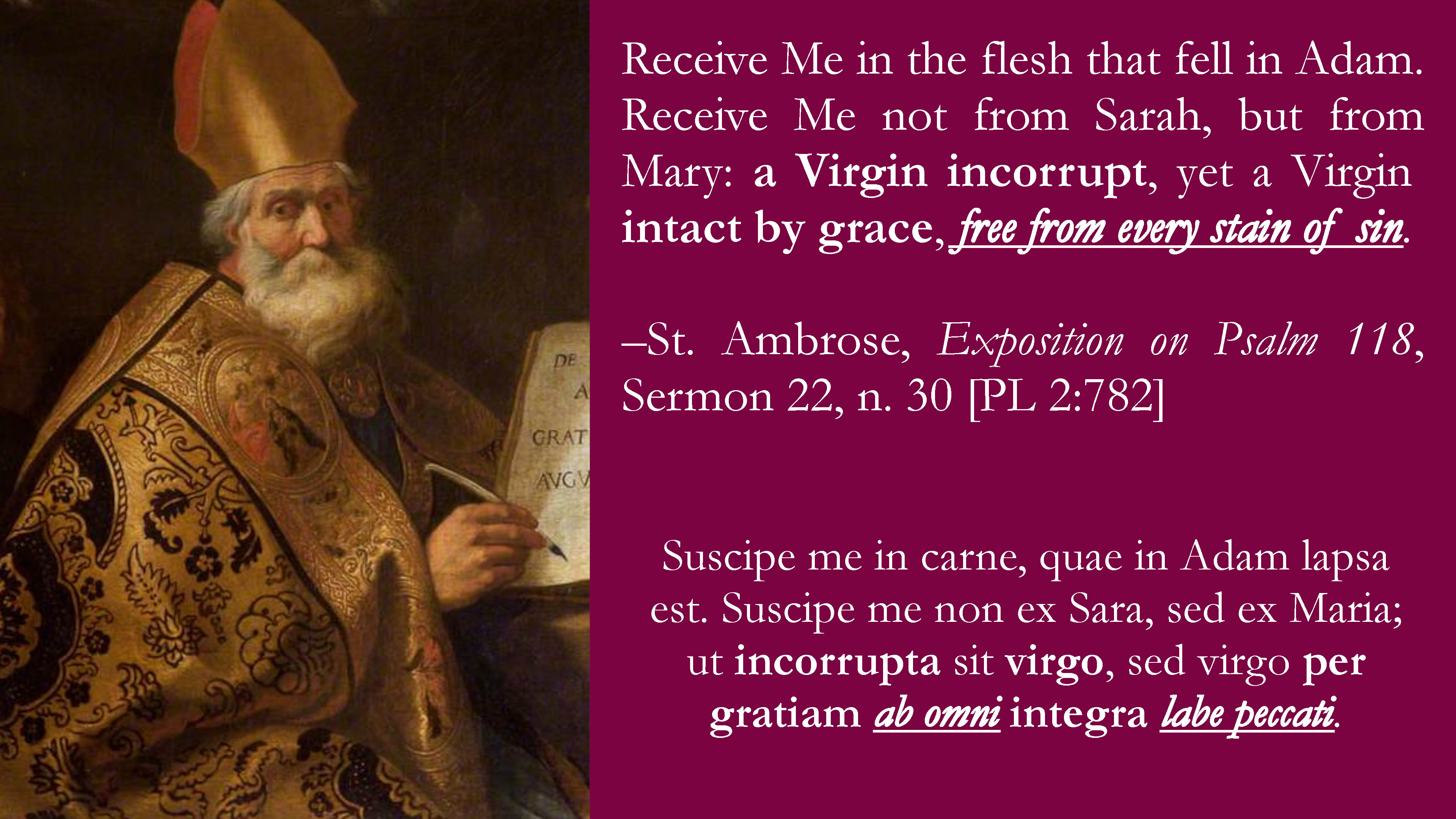
. . . Mary, a Virgin not only undefiled but a Virgin whom grace has made inviolate, free of every stain of sin.
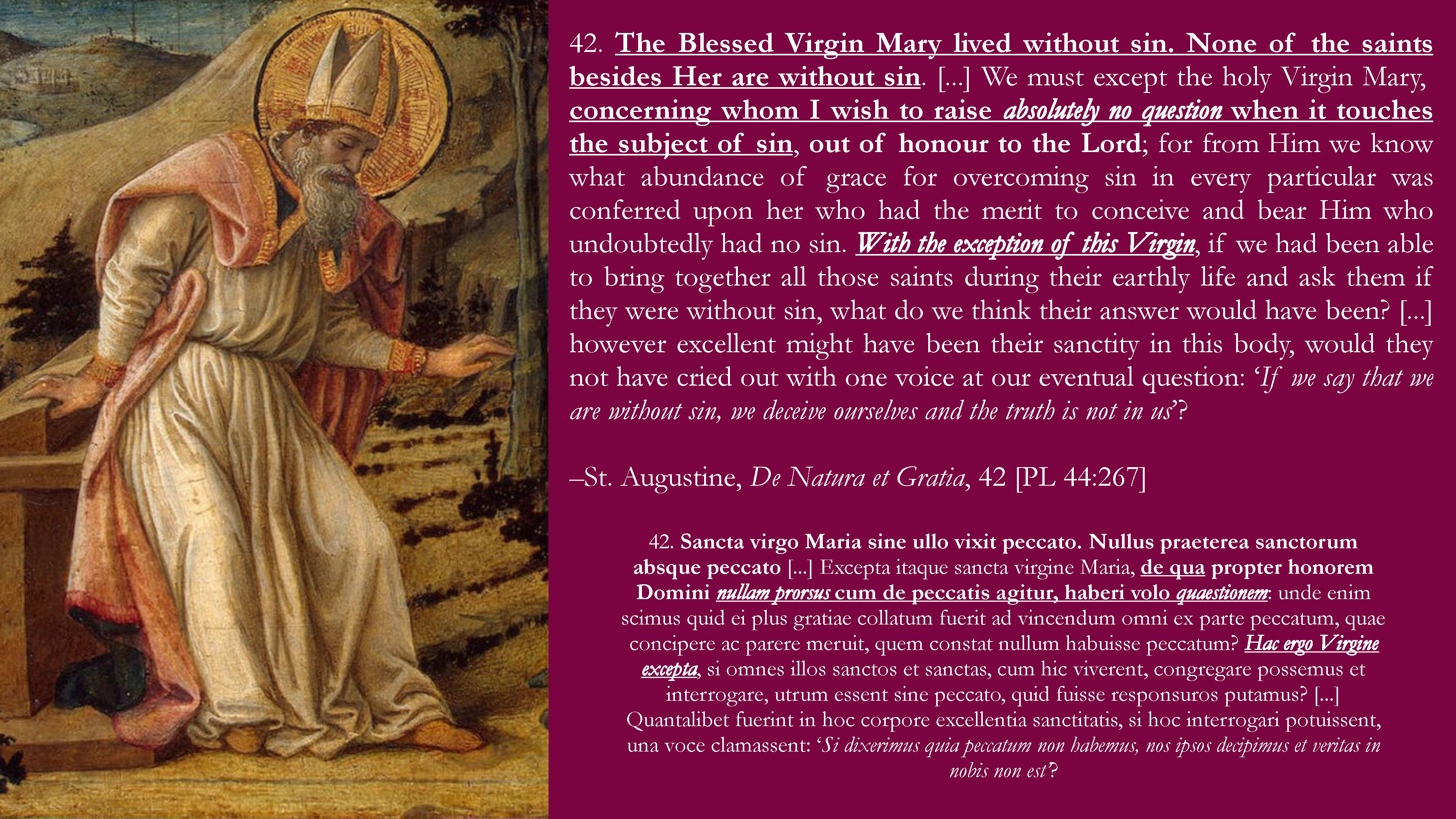
We must except the holy Virgin Mary, concerning whom I wish to raise no question when it touches the subject of sins, out of honour to the Lord; for from Him we know what abundance of grace for overcoming sin in every particular was conferred upon her who had the merit to conceive and bear Him who undoubtedly had no sin.
“The mystery of Christ’s wondrous love towards us shines out more especially in the fact that when dying He bequeathed His Mother to John the disciple as his mother, in His thoughtful testament: ‘Behold thy son.’ But, as the Church has always felt, in John Christ would signify the person of the human race, more especially those who would cling to Him by faith. Thus St. Anselm of Canterbury: ‘What more fitting, then, that thou, O Virgin, shouldst be the mother of those whose Father and Brother Christ deigned to be?’ (Oratio xlvii.) She, then, undertook her share in this exclusive and toilsome task and did great soul amid the consecrated tokens in the Upper Room.” (Acta Leonis XIII, xv, 302.)
“Was not Mary Christ’s Mother? Then she is our mother too. For all must needs agree that Jesus, the Word made flesh, is the Saviour of the human race. For as God-man He, like other men, received a material body; but as the Restorer of our race He received a certain spiritual body, the mystical body as we term it, namely the company of those who believe in Christ: ‘We being many are one body in Christ’ (Rom. xii, 5). But the Blessed Virgin did not conceive the Eternal Son of God only that He might be a man by taking human nature from her, but also that, through the nature derived from her, He might become the Deliverer of the human race. Wherefore the Angel said to the shepherds: ‘This day is born to you a Saviour who is Christ the Lord’ (Lk. ii, 11). Thus in one and the same womb of the most pure Mary did Christ both take to Himself human flesh and at the same time add a spiritual body, fashioned and growing together out of those who were to believe in Him. Hence, bearing in her womb the Saviour, Mary can also be said to have borne all those whose life the Saviour’s life enshrined. All of us, then, as many as are knit to Christ, and who, as the Apostle says, ‘are members of His body, of His flesh, and of His bones’ (Ephes. v, 30), have come forth from Mary’s womb, one body, as it were, knit together with its Head. Hence, in spiritual and mystic fashion we are called Mary’s children, and she is the mother of us all. ‘Mother spiritually, it is true, yet clearly mother of the members of Christ, which we are.’ (St. Augustine, De sancta Virginitate, 6.) If, then, the Blessed Virgin is Mother both of God and of men, who can question that she strives with all her power that Christ, ‘the Head of the body, the Church’ (Col. i, 18), may pour out His gifts upon us His members, and especially that ‘we may know Him and that we may live by Him’ (I Jn. iv, 9).” (Acta Pii X, i, 152.)
“It is clear, too, that this most sorrowful Virgin, since appointed by Jesus Christ as the Mother of all men, received them as a testament of infinite charity left to her, and fulfills with motherly kindness the task of forwarding their spiritual life; nor can she fail more especially to assist these most dear adopted children in that hour when it is a question of confirming unto eternity their salvation and sanctity.” (Acta Apostolicae Sedis, x, 182.)
“May Mary, the most holy queen of Apostles, kindly smile on all and prosper the work undertaken; for since on Calvary all men were entrusted to her motherly care, she does not less cherish and love those who are ignorant of the fact that they are redeemed by Jesus Christ, than she does those who happily enjoy the benefits of that Redemption.” (Acta Apostolicae Sedis, xviii, 83.)
For as the Word, he is consubstantial and eternal with God his father; but as taking flesh of the immaculate Virgin Mary, the Mother of God, he is perfect man, consubstantial with us and made in time.
In the last days of the world for us and for our salvation came down from heaven, and was incarnate of the Holy Ghost, and of our Lady, the holy, immaculate, ever-virgin and glorious Mary, truly and properly the Mother of God, that is to say according to the flesh which was born of her.
The use of “immaculate” to describe a person elsewhere in the council:
From all which it is evident that he had a human will by which he obeyed his Father, and that he had in himself this same human will immaculate from all sin, as true God and man.