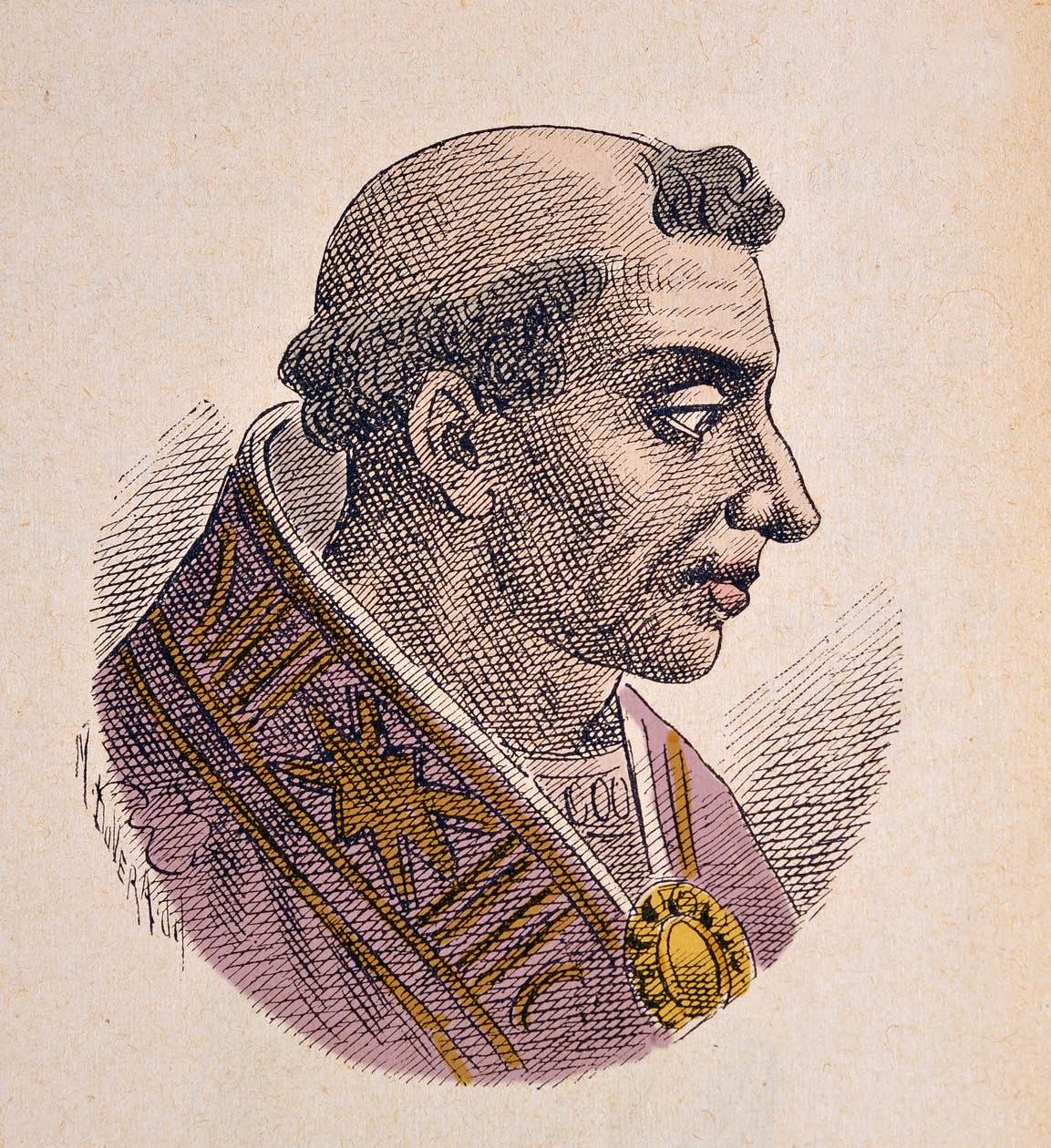
"Thus, Venerable Brethren, it is clear why this Apostolic See has never allowed its subjects to take part in the assemblies of non-Catholics. There is but one way in which the unity of Christians may be fostered, and that is by furthering the return to the one true Church of Christ of those who are separated from it; for from that one true Church they have in the past fallen away."
"Now if these only aimed at adapting ecclesiastical teaching and methods to modern conditions and requirements through the introduction of some new explanations, there would be scarcely any reason for alarm. But some through enthusiasm for an imprudent "eirenism" seem to consider as an obstacle to the restoration of fraternal union, things founded on the laws and principles given by Christ and likewise on institutions founded by Him, or which are the defense and support of the integrity of the Faith, and the removal of which would bring about the union of all, but only to their destruction."
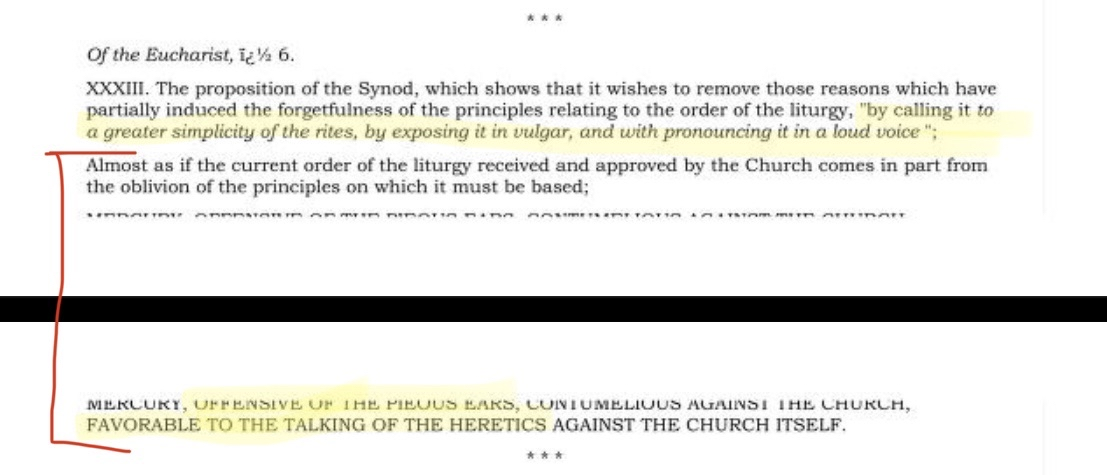
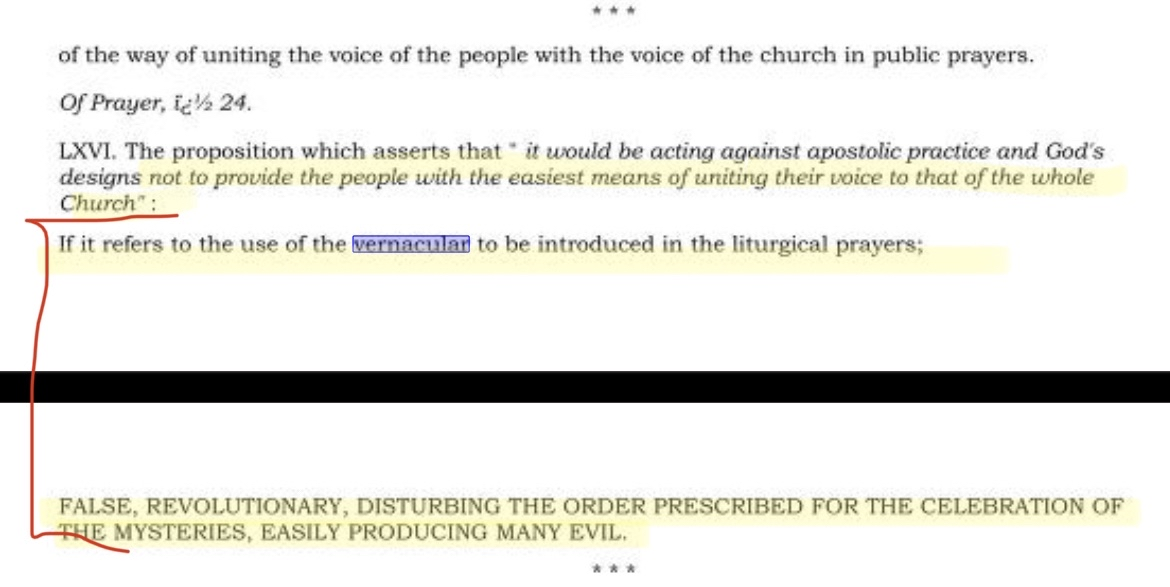
It seems to us that the answer to this question [of ‘Must We Attend A “Protestantized” Mass?’] is already to be found in your letter, where you speak of the “protestantized or protestantizing” Mass. And even if you would not be convinced of it, this danger was promptly denounced to Pope Paul VI by Cardinals Ottaviani and Bacci, with competence in the matter and due knowledge of the thing:
“...the Novus Ordo Missae—considering the new elements susceptible to widely different interpretations which are implied or taken for granted—represents, both as a whole and in its details, a striking departure from the Catholic theology of the Mass as it was formulated in Session XXII of the Council of Trent. The 'canons' of the rite definitively fixed at that time erected an insurmountable barrier against any heresy which might attack the integrity of the Mystery."
Now, a “protestantized” (in itself) and a “protestantizing” (for the mentality of those attending) Mass cancels the obligation to hear Mass on Sundays and holy days. The Church imposes the obligation to hear Mass “in the Catholic rite,” but a protestantized rite cannot at the same time be characterized as Catholic. Moreover, a “protestantizing” rite exposes the faithful to “considerable spiritual harm,” which is one of the strongest reasons exempting from the Sunday obligation of assistance at Mass. And as it involves danger for our own faith and for that of our dependents, for whom we are responsible before God, we must say that whoever is conscious of this danger, insofar as he is conscious of it, far from satisfying the Church’s precept, rather commits a sin against faith [by attending the N.O.M.].
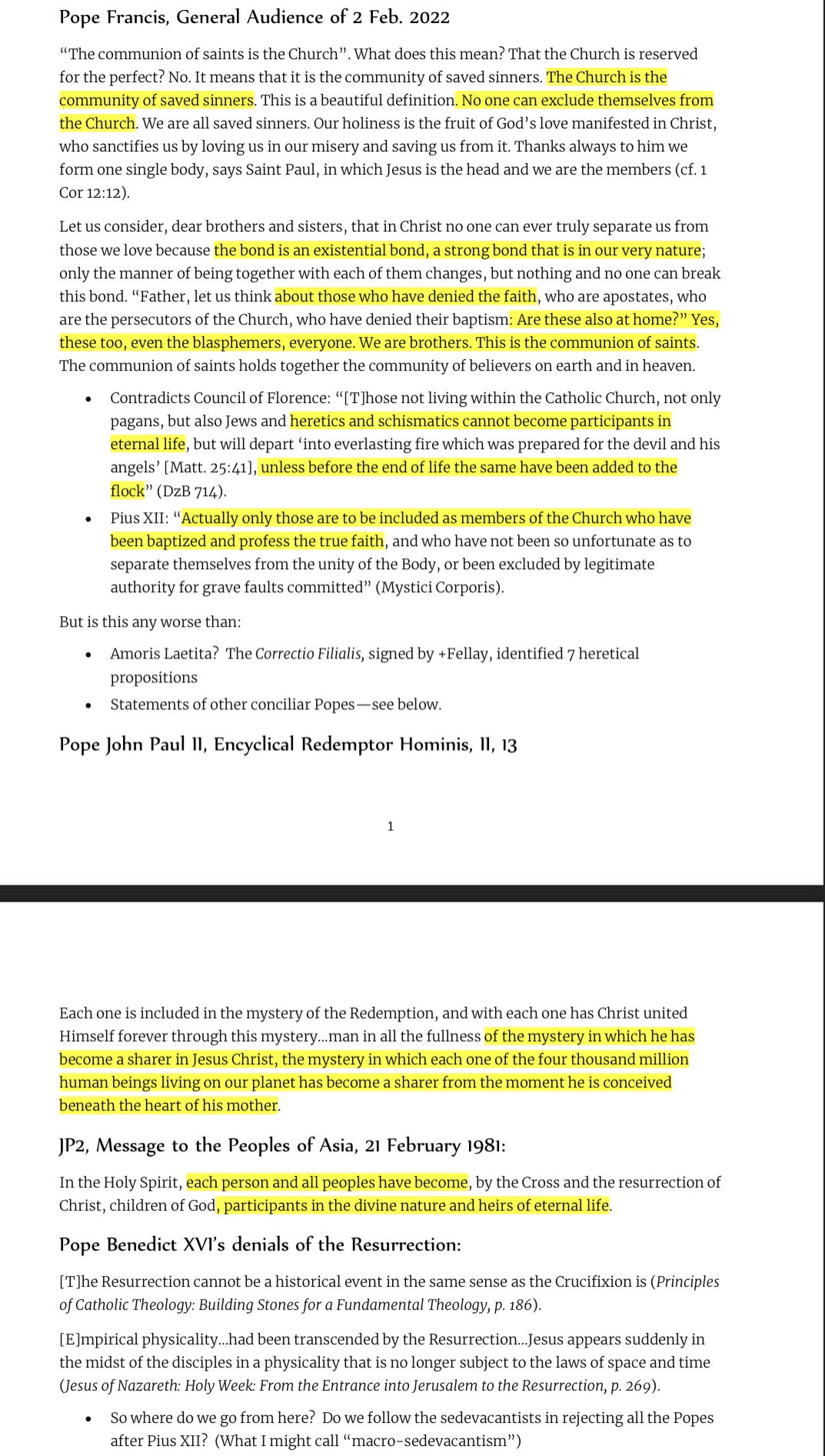
“I am very happy to meet you on the occasion of your ecumenical pilgrimage which began in the land of Luther, Germany, and ended here at the See of the Bishop of Rome… The Apostle Paul tells us that, by virtue of our baptism, we all form the one Body of Christ. The different members, in fact, form one body. This is why we belong to each other and when one suffers, everyone suffers, when one rejoices, all rejoice (cf. 1 Cor 12:12, 26). Let us continue with confidence on our ecumenical journey… At the end of this month, God willing, I will go to Lund, Sweden, and together with the Lutheran World Federation, we will commemorate, after five centuries, the beginning of Luther’s reformation…”
Contrast with: "The Reformation destroyed the unity of faith and ecclesiastical organization of the Christian peoples of Europe, cut many millions off from the true Catholic Church, and robbed them of the greatest portion of the salutary means for the cultivation and maintenance of the supernatural life. Incalculable harm was thereby wrought from the religious standpoint. The false fundamental doctrine of justification by faith alone, taught by the Reformers, produced a lamentable shallowness in religious life. Zeal for good works disappeared, the asceticism which the Church had practised from her foundation was despised, charitable and ecclesiastical objects were no longer properly cultivated, supernatural interests fell into the background, and naturalistic aspirations aiming at the purely mundane, became widespread. The denial of the Divinely instituted authority of the Church, both as regards doctrine and ecclesiastical government, opened wide the door to every eccentricity, gave rise to the endless division into sects and the never-ending disputes characteristic of Protestantism, and could not but lead to the complete unbelief which necessarily arises from the Protestant principles..."
2. A statement of Pope Francis:
“True reconciliation means that God in Christ took on our sins and He became the sinner for us. When we go to Confession, for example, it isn’t that we say our sin and God forgives us. No, not that! We look for Jesus Christ and say: ‘This is your sin, and I will sin again’. And Jesus likes that, because it was his mission: to become the sinner for us, to liberate us.”
Contrast with: “In the Sacrament of Penance the repentant Christian confesses his sins to a duly authorized priest, who, standing in the place of God, pronounces the absolution by means of which they are forgiven.” The Catechism Explained (Spirago-Clarke, 1899), Sacrament of Penance Q: How many conditions are necessary to make a good confession? A: To make a good confession five things are necessary: (1) Examination of conscience; (2) Sorrow for having offended God; (3) A resolution of sinning no more; (4) Confession of our sins; (5) Satisfaction or penance
They're not excommunicated as schismatics, because the Vatican has never said they are... You can... show that Lefebvre himself was not excommunicated and therefore no one else was... I come to the conclusion that, canonically speaking, he's not guilty of a schismatic act punishable by canon law. In the case of the Society of St. Pius X, the Vatican never declared any priest or lay person to have become a schismatic.
On June 28, 1993, the U.S. Apostolic Nuncio declared on Cardinal Ratzinger’s behalf the following:
From the examination of the case, conducted on the basis of the Law of the Church, it did not result that the facts referred to in the above-mentioned decree are formal schismatic acts in the strict sense, as they do not constitute the offense schism, and therefore the Congregation holds that the Decree of May 1, 1991 lacks foundation and hence validity.
Receiving the Sacraments from the Society do not incur excommunication, nor is this a truly schismatic act. This comes from the CDF (the director of which was Cardinal Ratzinger, future Pope Benedict XVI).
In November 2016, Pope Francis gave to the SSPX priests faculties to hear confessions.
"Given this need, lest any obstacle arise between the request for reconciliation and God’s forgiveness, I henceforth grant to all priests, in virtue of their ministry, the faculty to absolve those who have committed the sin of procured abortion. The provision I had made in this regard, limited to the duration of the Extraordinary Holy Year,[14] is hereby extended, notwithstanding anything to the contrary. I wish to restate as firmly as I can that abortion is a grave sin, since it puts an end to an innocent life. In the same way, however, I can and must state that there is no sin that God’s mercy cannot reach and wipe away when it finds a repentant heart seeking to be reconciled with the Father. May every priest, therefore, be a guide, support and comfort to penitents on this journey of special reconciliation. For the Jubilee Year I had also granted that those faithful who, for various reasons, attend churches officiated by the priests of the Priestly Fraternity of Saint Pius X, can validly and licitly receive the sacramental absolution of their sins.[15] For the pastoral benefit of these faithful, and trusting in the good will of their priests to strive with God’s help for the recovery of full communion in the Catholic Church, I have personally decided to extend this faculty beyond the Jubilee Year, until further provisions are made, lest anyone ever be deprived of the sacramental sign of reconciliation through the Church’s pardon."
"A final consideration concerns those faithful who for various reasons choose to attend churches officiated by priests of the Fraternity of St Pius X. . . I establish that those who during the Holy Year of Mercy approach these priests of the Fraternity of St Pius X to celebrat the Sacrament of Reconciliation shall validly an licitly receive the absolution of their sins."
". . . it is precisely because we do not wish to submit unconditionally to an authority without being sure that it wishes our good and will allow us to continue serving the Tradition of the Church without forcing us to accept Vatican II unconditionally."
In assessing Our duty and the situation now prevailing, We have been weighed upon by the thought that a matter of this kind [i.e. error in respect of the Faith] is so grave and so dangerous that the Roman Pontiff, who is the representative upon earth of God and our God and Lord Jesus Christ, who holds the fulness of power over peoples and kingdoms, who may judge all and be judged by none in this world, may nonetheless be contradicted if he be found to have deviated from the Faith. Remembering also that, where danger is greater, it must more fully and more diligently be counteracted, We have been concerned lest false prophets or others, even if they have only secular jurisdiction, should wretchedly ensnare the souls of the simple, and drag with them into perdition, destruction and damnation countless peoples committed to their care and rule, either in spiritual or in temporal matters; and We have been concerned also lest it may befall Us to see the abomination of desolation, which was spoken of by the prophet Daniel, in the holy place. In view of this, Our desire has been to fulfill our Pastoral duty, insofar as, with the help of God, We are able, so as to arrest the foxes who are occupying themselves in the destruction of the vineyard of the Lord and to keep the wolves from the sheepfolds, lest We seem to be dumb watchdogs that cannot bark and lest We perish with the wicked husbandman and be compared with the hireling.
Saint Thomas established a principle regarding a man’s submission to an authority in the text below. He used an analogy to demonstrate the concept, and he then applies it to a court. What can we apply it to? Well, here the lower authority may be replaced with the Roman Pontiff, whereas the higher authority may be replaced with Jesus Christ, the one whom the Pope reigns as Vicar of, as well as, most certainly, the Magisterium of the Church itself—no individual may contradict its declared dogmas and teachings or Catholic teaching in general. So also one may not contradict certain propositions such as those found in received tradition which are called certain and are more than safe. In instance we apply this as follows; should the Pope deviate from the apostolic tradition handed forth by God-made flesh, a man should not place his assent to the Pope’s actions or words. The lower authority remains in his position yet is ignored to some extent, while the higher authority is ever so powerful and worthy of perfect obedience.
A man should submit to the lower authority insofar as the latter observes the order of the higher authority. If the lower authority departs from the order of the higher, we ought not to submit to it, for instance if the proconsul orders one thing and the emperor another, according to a gloss on Rom. 13:2.
A former Pope explains the concept in practice.
"We read that the Roman Pontiff has always possessed authority to pass judgement on the heads of all the Churches (i.e., the patriarchs and bishops), but nowhere do we read that he has been the subject of judgement by others. It is true that Honorius was posthumously anathematized by the Eastern Churches, but it must be borne in mind that he had been accused of heresy, the only offense which renders lawful resistance of subordinates to their superiors, and their rejection of the latter's pernicious teachings."