Christ asks his Apostles who the folks they are evangelizing believe Jesus is. The Apostles reply that Christ is believed to be one of the great profits (Elijah, Jeremiah, and the recently beheaded John the Baptist are provided as examples). When Christ asks who the Apostles say that Jesus is, Simon Peter replies “You are the Messiah, the Son of the living God (Matthew 16:16).” In response to this proclamation by Simon, Christ refers to Simon as Peter for the first time (the original Greek word used in the Gospel is Cephas which means rock). While Kepha is the actually Greek word for rock, the word Kepha is considered a feminine term so Kephas is more appropriate in referring to Peter (this is an important point for one objection to the office of the Pope is the term Kephas actually refers to a pebble. This point is not linguistically accurate). Christ continues to tell Peter that the gates of hell will never prevail against the church that Christ will build upon Peter. He also provides Peter with the keys to the kingdom with the power to bind and loose.
The handing off of the keys, with the ability to bind and loose, is where the Church derives its teaching on the primacy of the office of the Pope in relation to doctrinal issues. The Holy Father is the successor to Saint Peter, who was granted the keys.
But where in scripture does it say this office is transferable? To answer this question, we look toward the Old Testament and the tradition of the handing over of keys. We read in Isaiah Chapter 22 of the prophesied fall of the kingdom of Judah. During this prophecy, the current master of the palace (in our current world terms prime minister would be an appropriate analogy) is replaced by a new servant called Eliakim. In this transfer of authority the keys to the kingdom are transferred, with these keys symbolizing authority and the ability to make decisions on behalf of the kingdom. This passage in Isaiah provides the understand of the importance of bestowing keys on a leader and how these keys are meant to be transferred to ensure this important office remains intact after a leader can no longer fulfill their position. We also learn of the appropriateness of the term Pope for this office. In Isaiah the office that is being transferred is described as one in which the descendants and offspring’s glory will be hung, which in effect is describing a father. We derive the word Pope from the Latin word Papa or Greek pappas, which is the way in which a child would refer to their father.
But do we have any biblical evidence of the primacy of Peter? The simple answer is a resounding yes! Peter is always listed first whenever the Apostles are listed in the scriptures, indicating his importance. After the miracle at Pentecost occurs in Acts, Peter stands up and instructs the faithful in the same manner that Christ would have prior to His death and resurrection (2:15-36). After Peter’s speech, the faithful ask Peter and the Apostles how they can become followers of Christ, to which Peter replies “repent and be baptized (Acts 2:38 NAB)” again demonstrating the primacy of his position.
If we move forward to Acts 15, we learn of an event that can be viewed as the first ecumenical council. As Paul and Barnabas were converting the Gentiles, a debate arose surrounding circumcision and its necessity under the new covenant. Rather than decide this on his own, Paul approaches Peter in Jerusalem to seek a ruling on this debate. We read in acts that the “Apostles and presbyters (priests) met together about this matter (Acts 15:6).” During this meeting Peter teaches them that the Gentiles are saved through the grace of Christ in the same manner that the Jews are, negating the burden of circumcision on them (this was an important discussion at the time because of the risk of infection associated with being circumcised in the ancient world). This teaching by Peter demonstrates his primacy over the Apostles and presbyters meeting to discuss matters of faith, a primacy he handed over through Christ’s bestowing of the keys on Peter. This office has continued for the 2,000 year existence of the Catholic Church just as Christ promised.
The answer is that Peter can be a pope even if Scripture does not use that title for him, just as God can be a Trinity even though Scripture does not contain the words “Trinity” or “Triune”. In both cases nonbiblical terms are used to clarify and understand biblical doctrines. For example, a vicar is one who acts as an agent or representative for a sovereign leader. So, when Jesus tells the apostles, “He who hears you hears me” (Lk 10:16), he makes them his vicars. In the third century Saint Cyprian said Jesus addressed this statement not only to the apostles, but to all the Church’s leaders as the apostle’s successors. One example of the specific vicarious role Peter played for Christ would be his condemnation of Ananias, who withheld money from the apostles. Ananias lied to Peter, but Peter charged Ananias with lying to God (Acts 5:3-4). Scott Hahn says, “As judge Peter acted as Christ’s vicar. To lie to Peter was to lie to God himself.”
Peter had unique authority both as the leader of the apostles and of the nascent Church. Peter’s role as “chief apostle” is evident in that he is mentioned in the Gospels more than every other apostle combined, often speaks for the whole group, and is placed first in every formal list of the apostles (Mt 10:2). Peter was also the recipient of the revelation that Jesus is the Son of the God (Mt 16:17-19), Jesus preached from Peter’s boat (Lk 5:3), and Peter was the first man Jesus appeared to after the Resurrection (Lk 24:34; 1 Cor 15:5). The angel at the tomb even instructed the women there to “tell [Jesus’] disciples and Peter that he is going before [them] to Galilee” (Mk 16:7).
The fact that Simon’s name was changed indicates he was given a divine commissioning. Whenever God changes someone’s name, it signifies a person’s new mission. For example, when Abram became Abraham his new mission was summarized in a name that means “the father of a multitude of nations” (Gen 17:5). The fact that Simon’s name was changed to the word “rock”, and Jesus says he will build his Church on “rock”, cannot be a coincidence. The Protestant biblical scholar Oscar Cullmann calls this an “obvious pun”, while Craig Keener says, “[Jesus] plays on Simon’s nickname, ‘Peter,’ which is roughly the English ‘Rocky’: Peter is ‘rocky,’ and on this rock Jesus would build his Church.”
Protestant objections to this interpretation frequently try to prove that the rock on which Jesus builds the Church is something other than Peter, such as Peter’s confession of faith. However, biblical symbols can refer to more than one thing (cf. Rev 17:9-10), and so the two are not exclusive. In fact, the Catechism of the Catholic Church says that the rock in this passage can also refer to Peter’s confession of faith and not just Peter himself (CCC 424). Thus, what the critic must do is show the rock cannot be Peter, not that it can be something else. Some Protestants say the rock must be Christ, and he alone, because Paul said Christ is the only foundation of the Church (1 Cor 3:11) and “the Rock was Christ” (1 Cor 10:4). McCarthy goes so far as to say that the name “rock” is symbolically applied only to God in Scripture and so it cannot refer to Peter in Matthew 16:18. But this is false. Jesus unmistakably refers to Simon Bar-Jona as Cephas / Peter / Rock—so the term “rock” must be used for more than just God in Scripture.
Further, in 1 Corinthians 10:4 Paul was referring to Christ being the rock Moses struck that, according to Jewish legend, followed the Israelites through the desert. Paul did not mean every rock in Scripture was Christ because Isaiah says Abraham was a rock from which the Jewish people were hewn (Is 51:1). This also refutes McCarthy’s claim that no one besides God is ever called “rock” in Scripture.Papal headship the formal element of councils
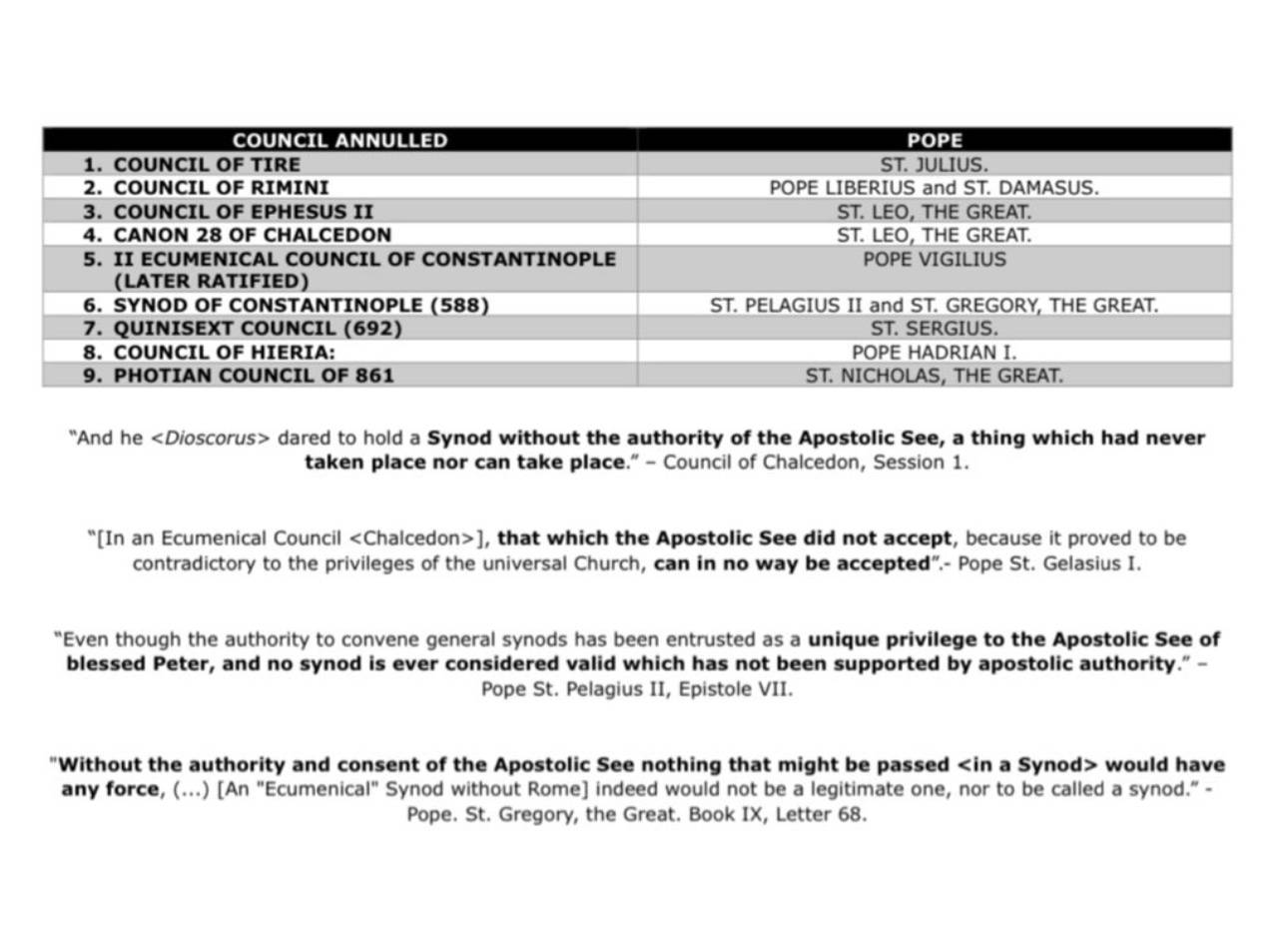
It is the action of the pope that makes the councils ecumenical. That action is the exercise of his office of supreme teacher and ruler of the Church. Its necessity results from the fact that no authority is commensurate with the whole Church except that of the pope; he alone can bind all the faithful. Its sufficiency is equally manifest: when the pope has spoken ex cathedra to make his own the decisions of any council, regardless of the number of its members nothing further can be wanted to make them binding on the whole Church. The earliest enunciation of the principle is found in the letter of the Council of Sardica (313) to Pope Julius I, and was often quoted, since the beginning of the fifth century, as the (Nicaean) canon concerning the necessity of papal co-operation in all the more important conciliary Acts.
The Church historian Socrates (Church History II.17) makes Pope Julius say, in reference to the Council of Antioch (341), that the law of the Church (kanon) forbids "the churches to pass laws contrary to the judgement of the Bishop of Rome" and Sozomen (III, x) likewise declares "it to be a holy law not to attribute any value to things done without the judgment of the Bishop of Rome." The letter of Julius here quoted by both Socrates and Sozomen directly refers to an existing ecclesiastical custom and, in particular, to a single important case (the deposition of a patriarch), but the underlying principle is as stated.
“Number the bishops from the see of Peter itself. And in that order of Fathers see who succeeded whom, That is the rock against which the gates of hell do not prevail.”
Who is the lawful successor of St. Peter in governing the universal Church?
"And that which the Prince of Pastors, the great Shepherd of the sheep, Christ our Lord, established in the Blessed Apostle Peter for the perpetual salvation and the enduring profit of His Church, that same must—by the action of the same Founder of the Church—last for ever in the Church, which, being founded on a rock, will stand firm to the end of the ages. 'For no one questions, nay rather has it always been well known, that the holy and blessed Peter, the Prince and head of the Apostles, the pillar of the faith and the foundation of the Catholic Church, received from our Lord Jesus Christ, the Saviour and Redeemer of the human race, the keys of the kingdom,' and that he, down to this present time and always, in his successors, the bishops of the holy Roman See founded by him and consecrated by the blood he there shed, 'lives,' presides 'and exercises judgment' (The Council of Ephesus, A.D. 431, see above, q. 126, p. 297). Consequently, whosoever succeeds Peter in this See, he, in accordance with the appointment of Christ Himself, holds Peter’s primacy over the universal Church. 'The appointment made, then, by the Truth, stands firm, and Blessed Peter, preserving in the rock-like strength he has received, does not relinquish the Church's helm put into his hands,' (St. Leo the Great, Sermo iii). It is for this reason that to the Roman Church, 'owing to its dominating principality, it is necessary'—as has always been the case—'that every Church should come—that is the faithful who are everywhere' (St. Irenaeus, Adv. Haer., III, iii), so that in that See whence there flow out to all 'the rights of religious fellowship' (the Council of Aquileia, A.D. 381), all, like members welded together through their head, grow into one compact body.
"If then, anyone shall say that it is not by Christ’s institution, nor by any Divine right, that the Blessed Peter has perpetual successors in his Primacy over the universal Church, or that the Roman Pontiff is not the successor of Blessed Peter in the same Primacy, let him be anathema."
“For to this Church [of Rome] it is necessary, owing to its dominating principality, that every Church should come—that is the faithful who are everywhere—for in that Church is preserved by those who are spread abroad the tradition derived from the Apostles.” (P.G., vii, 849.)
When they [St. Athanasius and other four bishops] had explained their case to Julius, Bishop of the city of Rome, he sent them back to the East strengthened by free letters and restored to each his see, as is the right of the Roman Church.
St. Athanasius would then be unjustly deposed again and exiled from his city of Alexandria. For this reason he went to Rome a second time:
When Julius, bishop of Rome, was apprised of these fresh machinations of the Arians against Athanasius, and had also received the letter of the then deceased Eusebius, he invited the persecuted Athanasius to come to him, having ascertained where he was secreted. The epistle also of the bishops who had been some time before assembled at Antioch, just then reached him; and at the same time others from the bishops in Egypt, assuring him that the entire charge against Athanasius was a fabrication. On the receipt of these contradictory communications, Julius first replied to the bishops who had written to him from Antioch, complaining of the acrimonious feeling they had evinced in their letter, and charging them with a violation of the canons, because they had not requested his attendance at the council, seeing that the ecclesiastical law required that the churches should pass no decisions contrary to the views of the bishop of Rome: he then censured them with great severity for clandestinely attempting to pervert the faith.